Boundary first
Name the system edge, physical state and responsible role before assigning a target.

A useful company overview separates brand language from the information a project team can verify. This site therefore focuses on requirement definition, responsibility boundaries, test records and operational handover rather than publishing unverified installation counts, funding claims, certifications or customer names.
The working principle is compact: state the load and flow, identify every control owner, test the difficult conditions and retain evidence that operations can use. Product fit, service coverage and response objectives remain subject to the quoted model, site and geography.
Warehouse robotics is often introduced through speed or flexibility. Engineering work begins one level lower: which physical item is present, which system believes it is present, what event authorizes movement and what happens when the expected confirmation does not arrive.
That perspective turns a broad automation ambition into a sequence teams can review. Receiving creates identity. Storage creates location state. An AMR or AGV mission connects demand to physical movement under fleet management system and safety laser scanner constraints. A workstation consumes or transforms the load. Dispatch closes the transaction. At each boundary, the WMS, WCS or WES, fleet manager, PLC and equipment controller need an explicit owner and an agreed timeout.
It also exposes trade-offs early. A centralized orchestration layer can provide coordinated optimization and one operational view, while a modular architecture can isolate some failures and reduce dependency on one layer. Flexible robots can support staged deployment and layout change, while fixed automation can provide deterministic capacity for stable flow. Neither choice is universally correct without demand, recovery and lifecycle context.
A compact review calendar often runs as a 2-week requirements lock, a 3-week interface freeze and a 1-week FAT script rehearsal before any site SAT window is scheduled. Those durations are planning defaults and are replaced by the quoted project calendar once scope, geography and access rules are confirmed.
A concise requirement is not a shorter specification. It is a specification where every target has a condition, an owner and a way to verify it.
Ambi Robotics review method note (internal working standard, not a third-party endorsement)
Name the system edge, physical state and responsible role before assigning a target.
Keep estimates in a dated register with sensitivity, owner and confirmation route.
Review blocked destinations, timeouts, lost identity, unavailable robots and controlled restart.
Carry input revision, script, observed result and issue disposition from FAT through SAT.
Automation changes more than travel distance. Operators need a clear way to recognize robot intent and request help. Maintenance personnel need isolation boundaries, compatible spares and a known restart authority. Controls teams need versioned backups and an alarm path that distinguishes physical, network and application conditions.
An operational-readiness review maps these roles to specific situations. It identifies who closes a crossing, who investigates a lost load identity, who can access diagnostics, who owns inventory reconciliation and who authorizes return to production. Training is then connected to real states instead of a generic system tour.
Safety requirements are treated as project evidence, not a logo row. ISO 12100, ISO 3691-4, ISO 13849-1 or jurisdictional machinery requirements may inform the review where applicable. Conformity and certification must still be confirmed for the legal entity, model, configuration, site and market; this page makes no certification claim.
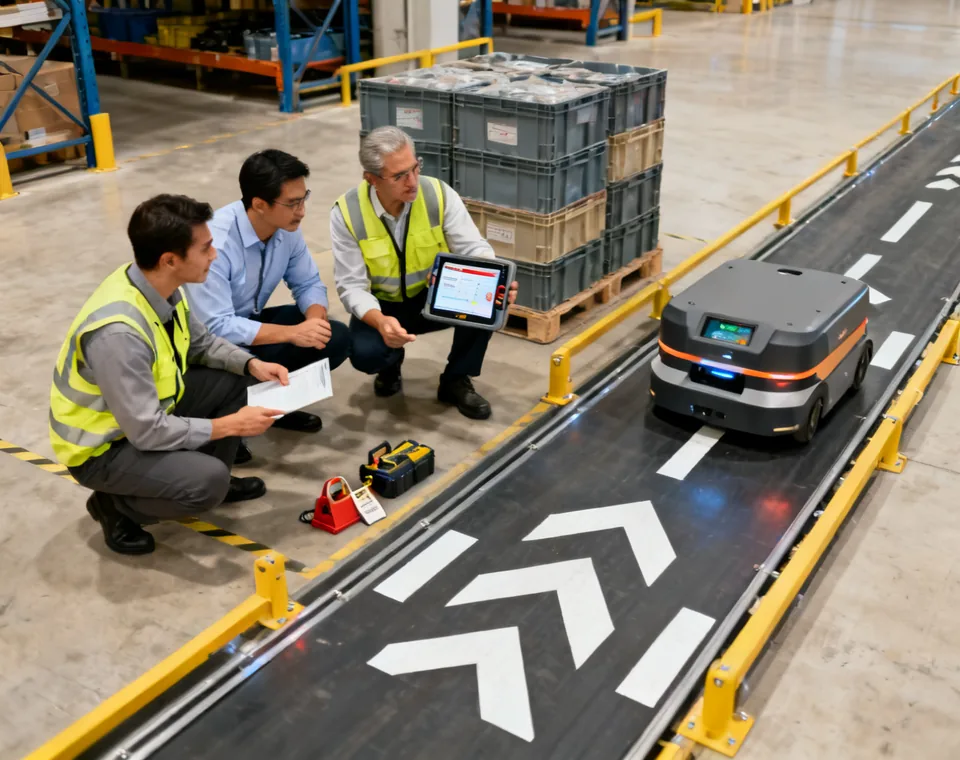
A narrow, representative flow can reveal interface and recovery questions faster than a broad capability list. Share the load, mission, handoffs and the condition your current operation finds hardest to recover.
The response will be scoped to the information supplied. Any technical output remains subject to confirmation of actual product configuration, site constraints and applicable requirements.