Inbound identification
Confirm load identity, arrival variability, induction position and the handoff that creates a valid transport mission.
Open catalog →Start with receiving, storage, picking, sortation and shipping as connected operating states. Load geometry, order release, AMR/AGV traffic, safety laser scanner fields, WMS/WCS ownership and exception recovery remain visible from the opening concept review.
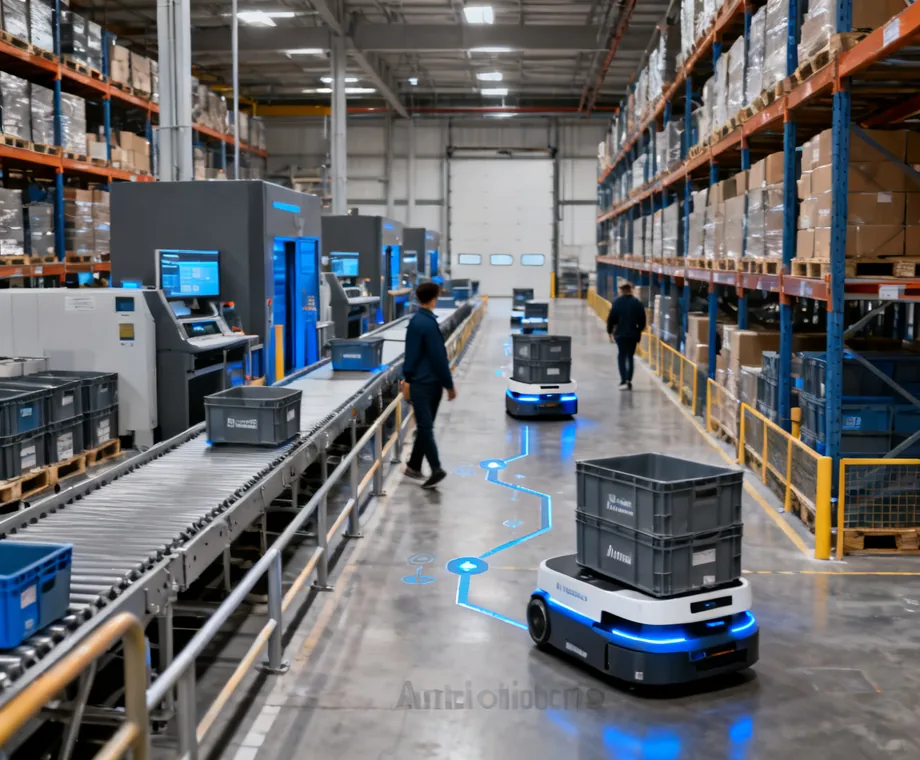
The project view organizes equipment around the movement it must complete. This prevents a product name from replacing the process definition.
Confirm load identity, arrival variability, induction position and the handoff that creates a valid transport mission.
Open catalog →Define tote or pallet destinations, occupancy limits, replenishment priority and what happens when a destination is blocked.
Open catalog →Review payload, aisle geometry, crossings, traffic rules, battery strategy and degraded operation with robots unavailable.
Open catalog →Connect workstation cadence to tote presentation, operator replenishment, reject paths and downstream accumulation.
Open catalog →Describe cutoff logic, destination capacity, recirculation, late orders and the ownership of reroute decisions.
Open catalog →Align physical delivery with WMS state, dock staging, carrier cutoff and recovery when the final confirmation is delayed.
Open catalog →This compact specification view separates customer inputs, design outputs and acceptance evidence. Values below are required fields, not published product claims.
Vertical labels are discovery shortcuts. The actual design still depends on item depth, order behavior, load mix, temperature and the consequence of interruption.
| Profile | SKU and demand | Load mix | Peak and environment | Review emphasis |
|---|---|---|---|---|
| E-commerce | Deep SKU range, small orders, cutoff waves and promotion volatility. | Totes, cartons and mobile shelving. | Short sustained peaks with dense human interaction. | Station balance, congestion and backlog clearance. |
| Grocery | Store sequence, replenishment demand and freshness windows. | Totes, cartons, roll cages and occasional pallets. | Time-sensitive dispatch and possible temperature zones. | Zone transition, sequence integrity and battery duty. |
| Manufacturing | Consumption linked to takt, work order and component call-off. | Bins, totes, carts and returnable containers. | Stable cadence with a high consequence for missed delivery. | Priority logic, line-side handshake and manual fallback. |
| Cold environment | Controlled inventory with dwell and access constraints. | Sealed totes and compatible pallet or rack interfaces. | Temperature affects battery, sensors, condensation and labor access. | Material suitability, charging and recovery procedure. |
Begin with representative data rather than a headline rate. Mark every estimate as an assumption and name the person who can confirm it.
Open the project brief